
-

Try advanced features for free
Get Smarter responses, upload files, create images, and more by logging in.
Log In Sign up & Earn $5

What is Multimodal AI & How Does it Work: A Detailed Guide

It is not possible to build your business infrastructure on old and text-only systems. Therefore, brands need to adapt to the latest technology to remain competitive in this rapidly changing market. It is because industries can ruthlessly punish inefficiency. Depending entirely on a basic text analyzer to process complex operational data is a massive liability. The modern landscape demands systems capable of pulling context from a wide variety of inputs simultaneously.
What is Multimodal AI?
The tech landscape shifts rapidly. Relying on outdated systems guarantees you fall behind. You cannot solve complicated and tough problems with the old tools that can only read text. The market demands systems capable of seeing and reading simultaneously. Therefore, multimodal AI refers to artificial intelligence architectures engineered to process, analyze, and integrate multiple data types such as text, images, video, etc. at the exact same time.
How Does Multimodal AI Work: Step-by-Step
You can check below to understand how multimodal AI works:
1. Standardizing the messy raw inputs
The initial data is an absolute disaster when it first enters the system. A model cannot instantly analyze a raw audio recording sitting right next to a written file. First, the architecture has to clean everything up. It chops text into readable tokens, scales down huge images to match strict processing dimensions, and turns sound waves into visual maps.
2. Routing files through dedicated encoders
You cannot shove a massive video and a text document through the exact same neural network and expect a good result. The system separates the data types from the very start. Text goes straight into a transformer setup. Visuals get pushed into a specialized neural network.
3. Smashing the numbers together in data fusion
This is where the actual intelligence is formed. The framework takes those isolated numbers and forces them into a shared mathematical space. The model logically connects the dots across completely different media. It figures out that a picture of an engine fire directly matches the audio file of an explosion and the text string for a critical failure.
How Does Multimodal AI Differ from LLMs?
The following list will help you understand how multimodal AI differs from LLMs:
1. Restriction of single-modality processing
Large Language Models (LLMs) are strictly confined to analyzing and generating textual data. They excel at reading long documents, summarizing dense reports, and writing marketing copy because their entire architecture is explicitly optimized for language processing. Multimodal systems violently break this text-only barrier. They are built from scratch to simultaneously analyze static images and video files alongside written prompts. It gives them a drastically wider operational scope.
2. Fundamental architectural complexity
An LLM generally operates on a single-transformer architecture designed exclusively to process sequential data and predict the next word in a text string. It is a highly specialized but straightforward pipeline. A multimodal model requires a drastically heavier, significantly more fragmented architecture. It must house multiple independent encoders to physically handle the different sensory inputs before relying on a heavy fusion module to accurately align the conflicting data types into a unified mathematical space.
3. The brutal demand for computational horsepower
Because standard LLMs only process text, their fundamental training requirements are highly manageable compared to their multi-sensory counterparts. Multimodal frameworks demand staggering amounts of raw computational resources to function properly.
What are the Benefits of Multimodal AI for Businesses?
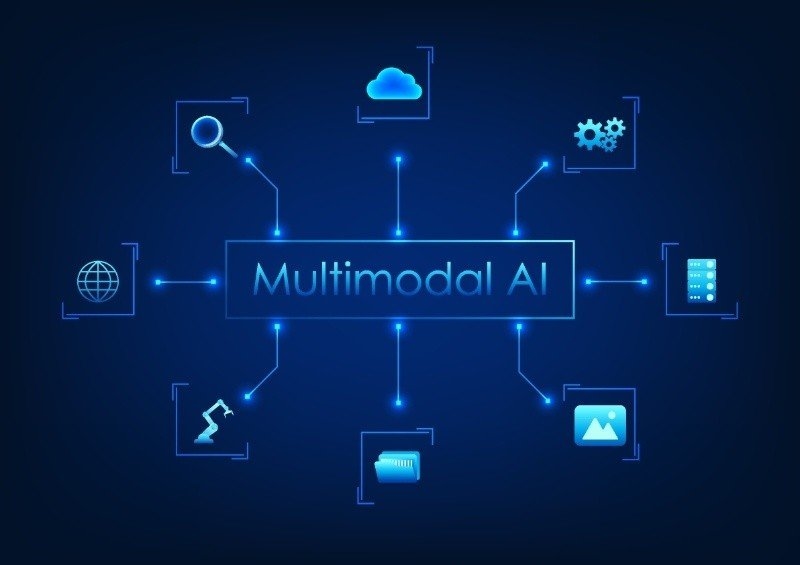
The benefits of multimodal AI to businesses are explained in the following list:
1. Executing hyper-accurate data analysis
Enterprises no longer have to rely on siloed data streams. You can feed financial reports, recorded earnings calls, and market trend charts into a single system simultaneously. The model cross-references the tone of an executive's voice with the hard numbers in the spreadsheet to extract nuanced insights that a basic text analyzer would completely miss.
2. Automating complex quality control
Manufacturing and logistics processes may apply these models in conducting autonomous inspections. The process involves integrating live images obtained from cameras with sensor information, allowing instant identification of faulty products at an assembly line and automatically recording detailed textual defect reports in the database system without human intervention.
3. Upgrading customer interaction channels
Static chatbots are a liability. Multimodal virtual assistants allow customers to upload a photo of a broken product, explain the issue via a voice note, and receive a highly accurate, customized troubleshooting guide in real time. It fundamentally eliminates friction in customer support and drastically reduces resolution times.
Do not settle for just simple and text-based user interfaces while scaling up internally. In case of an advanced and fully functional conversational engine requirement, you need to use TalkGPT. It functions as an excellent platform that ensures the best-in-class natural language processing and generates content with precision. TalkGPT enables your employees to automate their workflow and process huge datasets within no time. TalkGPT equips you with all the necessary infrastructure required to increase productivity at a faster pace through an efficient AI assistant.
Conclusion
The integration of multi-sensory data processing is the new baseline for enterprise technology. You must move past basic text generators and adopt systems capable of perceiving the world through multiple lenses. Understanding what multimodal AI is and leveraging its raw analytical power allows you to automate complex tasks, extract deeper insights, and build applications that actually solve real-world problems.
Frequently Asked Questions
1. How do data privacy regulations impact the deployment of multimodal AI?
Deploying a multimodal AI triggers massive regulatory hurdles because the technology actively ingests highly sensitive biometric data. When a system processes the live facial recognition feeds or raw voice recordings, they are subjected to brutal federal privacy laws.
2. What are the primary latency challenges associated with multimodal AI?
The problem of having to process heavy and varied data streams simultaneously results in a significant computational bottleneck. In an instance where a multimodal AI seeks to align a live high-definition video stream with instant audio translation in real time, the heavy amount of data is what normally leads to lag on the system. As such, the engineers have to do their utmost to optimize the edge computing systems in a bid to make instantaneous processing happen.
3. How does open-source availability influence the growth of multimodal AI?
Open-source systems revolutionize the entire process of building a multimodal AI by making things completely different. Gone are the days when developers had to incur huge licensing costs in order to use legacy technology.
Recommended Articles

How Does an AI Chatbot Work an...
Key TakeawaysAn AI chatbot reads a message, guesses what the pe...
Read More
How AI is Transforming Investi...
Investing used to be a slow game. People pored over thick report...
Read More

What can I help you with?
Unlock more with TalkGPTPlus
TalkGPTPlus gives you higher limits, smarter models, and more.