
-

Try advanced features for free
Get Smarter responses, upload files, create images, and more by logging in.
Log In Sign up & Earn $5

What Is AI Workflow Automation and How Does It Work?
The way businesses manage repetitive tasks, increase productivity, and cut operational expenses is being revolutionized by AI workflow automation. Statistics show that organizations that use AI-powered automation can reduce manual workload by 40% while simultaneously improving process speed and accuracy. Businesses have to use AI across every aspect, from customer service to marketing, HR, and finance.
The intelligence and decision-making abilities of AI systems differ from those of conventional automation, where processes strictly follow predetermined instructions. AI systems are capable of learning, recognizing patterns, and making judicious decisions based on information. With all this, AI can manage the most complex business processes better than existing forms of automation. There is also a massive revolution in AI workspace automation.
Whether you are an entrepreneur, a manager, or simply an individual intrigued by technology, understanding intelligent workflow automation with AI is the first and crucial step towards embracing this transformative change. This article explains what intelligent workflow automation is, how AI workflow automation works, its functions, benefits, uses, challenges, and implementation for businesses.
What is AI Workflow Automation?
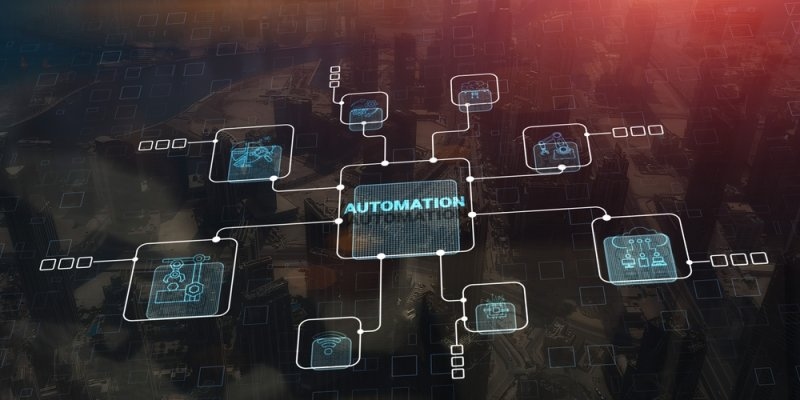
AI workflow automation uses artificial intelligence to automate business tasks and processes that require human involvement. It integrates automated processes using machine learning, predictive analytics, and natural language processing.
While traditional automation is based on predetermined instructions, AI-driven automation, on the other hand, analyses, learns, and decides based on data.
For instance, a traditional process could automatically issue invoices; an AI-driven process could analyze invoices, identify irregularities before issuing them, prioritize invoices, and predict potential late payments.
How Does it Work?
Understanding the processes of AI-driven workflow automation will help you understand how it functions. It starts from data:
1. Collection of data
Every automated process begins with data, which can be collected from emails, websites, databases, CRM systems, customer feedback, and more. These pieces of information form the base for all automated processes and decisions.
2. Data analysis and learning
Using its intelligence, an AI algorithm analyzes data to discover patterns and understand behaviors. Machine learning models refine this analysis by processing larger quantities of data. Thus, a more precise recommendation or prediction can be made each time.
3. Making a decision
Once data has been thoroughly analyzed, an AI makes a smart decision regarding a course of action. It can decide how to respond to a customer inquiry, categorize and prioritize tasks, and even assign them to the appropriate employee. This requires minimal human interaction.
4. Automated operation
Once a decision is taken, the appropriate automated step will be executed. This might be the generation of reports, sending a reply to a customer, filling out forms and applications, and processing approvals. All this is completed with very minimal human input.
The most important elements of intelligent workflow automation:
The integration of several tools leads to efficient intelligent workflow automation systems:
Machine Learning (ML)
ML enables the system to learn from historical data, thereby refining its decision-making accuracy. It is used for classifying data, making predictions, identifying trends, etc.
Natural Language Processing (NLP)
NLP enables AI to understand and interpret human language, which is used in applications such as chatbots, virtual assistants, and support systems.
Robotic Process Automation (RPA)
RPA automates digital tasks, such as updating records, processing data from the system, and sending it. These tools can perform much smarter operations when integrated with AI.
Predictive Analytics
This technology is used to make forecasts based on past results and available information. The information is utilized to predict customer behavior, market trends, demand forecasts, and future risks in business operations.
Advantages of AI Workflow Automation
Businesses are increasingly implementing automated business processes due to the advantages they offer.
Boost productivity
Employees spend less time on routine and administrative tasks, allowing them to focus on strategic and decision-making roles, thereby enhancing overall productivity and efficiency.
Reduce errors
AI, having consistent programming standards, always adheres to predefined principles in its operations, minimizing errors. The anomalies are identified by the AI even before they may lead to issues.
Expedite decision-making
The AI analyzes massive volumes of data in mere seconds, enabling the organization to make faster, data-driven decisions.
Reduce operational costs
Repetitive, monotonous tasks have been automated, saving significant labor costs and resources. Many organizations have seen a dramatic reduction in operating costs while maintaining optimal service quality.
Provide better customer experiences
Customer complaints and queries are handled more efficiently, and a personalized response can be formulated for specific customers. This leads to a much better customer experience and increased satisfaction.
Try This: How to Use AI for Small Business Marketing & Better Results
Applications of AI in business workflow
AI-driven workflow automation is utilized in many business sectors:
Customer service
Chatbots are used to answer common customer queries and manage customer support, providing timely solutions to their problems 24/7.
Marketing
The AI enables marketing campaigns to be tailored to each customer, so their individual preferences are addressed. Targeted ads can also be formed using customer data to predict customer demand.
Human resources
HR managers can use these systems to screen applicants' resumes, manage the employee onboarding process, provide employee support, and even track employee performance.
Finance and accounting
Businesses have found that AI has drastically automated accounting and financial processes, reducing errors, improving transaction efficiency, and ensuring data integrity. Invoice and expense management, risk assessments, and even fraud detection can be handled by an AI system.
Supply Chain Management
With regard to supply chain management, integrating AI workflow automation could improve business operations, such as demand forecasting, inventory control, managing demand-supply gaps, and operational planning, for more efficient, productive output.
Challenges in AI workflow automation
Despite the advantages that AI workflow automation could bring, there are difficulties that might be encountered.
Data Quality
Data Quality in machine learning: the more accurate and reliable the data is, the better the AI model's output. Thus, incorrect and missing data would hinder the efficiency and effectiveness of machine learning in AI, hindering the ability to make appropriate decisions.
Integration Challenges
There might be many problems with integrating automation into current business processes. This is not an easy task and is costly.
Security and Compliance
When using sensitive information, ensure the data used to provide support and solutions is accurate and confidential, and that it addresses relevant security and compliance issues. Careful consideration and planning would be required to protect data from hacking and breaches.
How to Begin with AI Workflow Automation?
A business first needs to identify time-consuming, repetitive tasks that take up a lot of employees' time. Second, the existing business processes should be studied to determine how an automated workflow can deliver significant benefits to the company. One should start with simpler automation procedures before moving to more complex ones. Third, the right platform for implementing automation needs to be selected-a platform that integrates easily with current systems and scales as the business grows. Finally, one must continue monitoring and improving workflow automation as business and operational objectives change.
Conclusion
AI workflow automation helps companies grow by enabling intelligent, automated systems. By learning, analyzing, and making decisions based on the collected data, AI-driven automation supports each task and makes the automation process even more effective. This not only helps achieve higher productivity but also cuts costs and enhances the customer experience. It is clear that business automation is not a choice but a necessity for companies looking to prosper in the competitive digital age. The use of platforms such as gptdrive.com can also help organizations and their employees understand how to integrate and enhance their business processes with automation.
Frequently Asked Questions:
Can Small Businesses Adopt AI Workflow Automation?
Yes. There are a number of AI workflow automation tools that are designed to suit small businesses' budgets and needs. Many cloud-based platforms are user-friendly and can handle various tasks such as sending reminders, invoicing, customer support, and marketing campaigns with very few resources. These are the reasons why small businesses are likely to see great returns with little investment in hardware.
Is AI Workflow Automation Going to Replace Human Workers?
AI workflow automation aims to support human employees, not replace them. This will allow them to focus on higher-level, more creative, and strategic functions rather than repetitive, monotonous tasks. Often, AI serves as a tool to make human jobs much easier.
How Long Does it Take to Automate a Business Process?
The time required to automate a business process depends on the task and its complexity, whether there are existing systems and procedures to support it, and the business's needs for implementing the automation. Simple tasks may be completed within weeks, while more complex, system-wide projects may take several months. Smaller projects executed well will eventually lead to easier and smoother large-scale business processes.
Recommended Articles

Ethical AI Strategies for Resp...
AI isn't hitting pause-it's only speeding up, way faster than mo...
Read More
How AI is Changing Freelancing...
The question of how AI is changing freelancing and remote work i...
Read More
What can I help you with?
Unlock more with TalkGPTPlus
TalkGPTPlus gives you higher limits, smarter models, and more.